








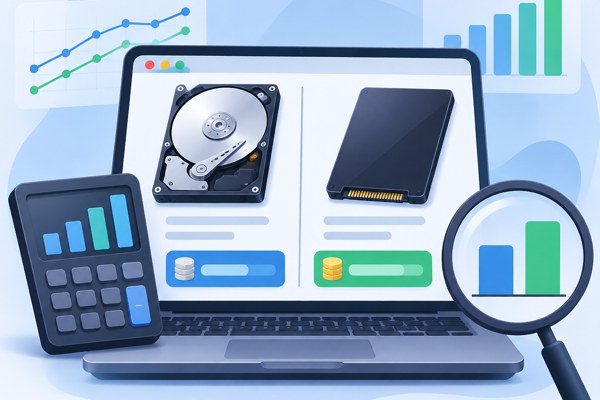
Choosing the right storage solution for your computer or project requires balancing cost, performance, and capacity. Hard Disk Drives (HDDs) and Solid State Drives (SSDs) continue to be the dominant options, with distinct price differences based on how much data you need to store. Understanding cost per terabyte can help you pinpoint the best value for your specific needs while avoiding overpaying for either capacity or speed.
Understanding Price per Terabyte and Why It Matters
When comparing HDDs and SSDs, looking at the headline price alone can be misleading. The price per terabyte (TB) measures how much you pay for each unit of storage, making it a practical yardstick to evaluate value, especially when capacity varies widely between products.
Here are some important points about price per terabyte:
- It standardizes the cost comparison, regardless of storage size.
- It helps identify if a larger capacity drive actually offers better value.
- It is key for budget-conscious users and businesses managing large data sets.
As of November 2026, HDDs cost roughly $0.03 to $0.045 per gigabyte (GB), translating to about $30 to $45 per terabyte. In contrast, SSDs are significantly more expensive, ranging from $0.09 to $0.10 per GB ($90 to $100 per TB), often two to three times the cost of HDDs at the same capacity.
Using Disk Prices Tools for Accurate Comparisons
Price trends fluctuate due to market supply, demand, and manufacturing changes. To keep up, specialized platforms like Disk Prices Tools offer a comprehensive and up-to-date database of HDD and SSD prices, including detailed specifications and price per terabyte metrics. With over 1,300 listings, you can sort drives by capacity, cost efficiency, and drive type.
Benefits of using Disk Prices Tools include:
- Real-time pricing updates aggregated from multiple retailers.
- Easy filtering to compare drives with similar specs.
- Quick identification of high value drives for specific use cases.
- Access to price trends helping predict future cost shifts.
Key Factors to Consider Beyond Price per Terabyte
Price isn’t the only factor when selecting a drive. Consider these critical attributes alongside cost per TB:
- Capacity Needs: Are you storing backups, media libraries, or working with large datasets? Higher capacity is often more economical with HDDs.
- Speed and Performance: SSDs generally outperform HDDs with faster read/write speeds, crucial for applications needing quick data access like video editing or gaming.
- Durability and Reliability: SSDs have no moving parts, making them more resistant to shocks, while HDDs may last longer for sequential writes but are prone to mechanical failure.
- Warranty and Support: Drives from brands like Seagate IronWolf Pro and SanDisk Extreme Portable SSD not only offer competitive pricing but also come with robust warranties suited for NAS systems or professional use.
Evaluating these factors ensures you choose a storage solution optimized for both your budget and performance demands.
Pricing Trends and Market Influences
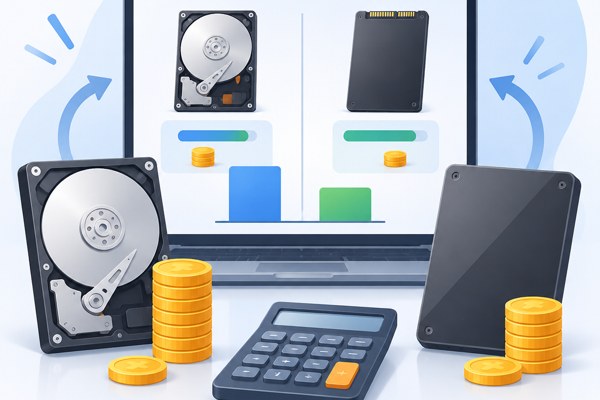
While HDDs remain the most budget-friendly option for bulk storage, recent market factors have caused SSD prices to rise sharply. The significant demand from AI data centers and NAND component shortages have pushed some SSD costs nearly three times their original MSRP. For example, the SanDisk Extreme Portable SSD, popular for its speed and rugged design, can be found discounted occasionally but still commands a premium compared to HDDs.
This dynamic means the price gap between SSDs and HDDs might widen or narrow depending on external factors. Regularly monitoring reliable sources like BuyPerUnit can help you time purchases and choose the right drive based on current market conditions.
Checklist for Making the Right Storage Purchase
- Identify your storage capacity requirements (e.g., 1TB, 4TB, 8TB).
- Evaluate if faster data access or durability justifies the SSD premium.
- Use Disk Prices Tools to compare price per terabyte across models and retailers.
- Check warranty terms and manufacturer reputation for reliability.
- Monitor pricing trends for discounts or price drops before buying.
- Consider whether your use case involves bulk archival (favor HDDs) or frequent, high-speed access (favor SSDs).
Making an Informed Decision
Choosing between HDDs and SSDs ultimately depends on your unique requirements and budgets. If maximum storage for minimal cost matters most, HDDs remain unbeatable at about $49 per terabyte on average. On the other hand, if speed, durability, and energy efficiency are priorities, then investing in SSDs despite higher costs may pay off.
You can explore more practical guides on optimizing your development projects and tech builds over at TechZog development section. Staying informed about market trends and leveraging advanced comparison tools ensures you get the best value for your storage purchases today and tomorrow.