








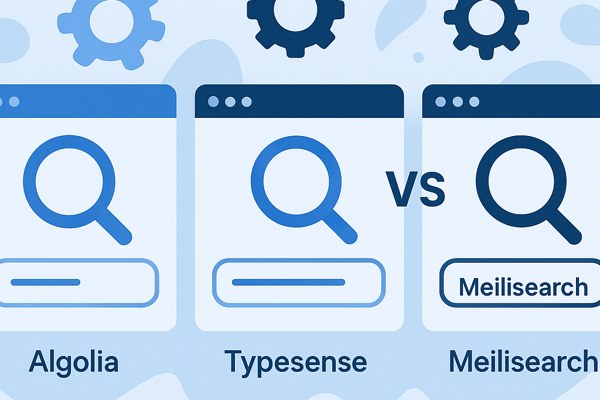
Choosing the right search engine for your application can greatly influence user experience, conversion rates, and overall engagement. With popular options like Algolia, Typesense, and Meilisearch on the table, it’s important to understand their features, costs, deployment flexibility, and performance. This guide compares these three search engines to help you make an informed choice based on your needs.
Core Features and Search Capabilities
Each search engine brings distinct features that can impact how search works for your app or website.
- Algolia offers a comprehensive cloud-based solution with advanced search features such as NeuralSearch, AI Collections, and Smart Groups. These capabilities enhance relevance and personalization, ideal for e-commerce platforms and applications requiring tailored user experiences.
- Typesense is open-source and optimized for speed and simplicity. It supports typo tolerance, faceting, filtering, and vector search. Its support for AI agents and language models allows you to build advanced search functions without complexity.
- Meilisearch focuses on ease of use and speed, offering full-text search, vector search, and hybrid retrieval combining keyword and semantic search. This makes it suitable for applications aiming for accurate and nuanced search results.
Pricing Considerations
Understanding pricing models is crucial, especially when scaling search services with growing data and search volumes.
- Algolia provides a free tier with 10,000 monthly search requests and up to 50,000 records. Paid plans like Grow and Grow Plus scale with the number of search requests and stored records, which fits businesses expecting steady growth and cloud-first infrastructure.
- Typesense uses a resource-based pricing model charged hourly depending on RAM and CPU usage, starting at $0.03/hour for the smallest cluster. This model is flexible for usage that varies over time and supports self-hosting options, helping control costs.
- Meilisearch offers both usage-based and resource-based billing with a Cloud plan starting at $20/month. It features a 14-day free trial, allowing a hands-on evaluation without credit cards. This hybrid pricing works well for teams wanting transparent costs while experimenting with the service.
Deployment and Scalability
Deployment flexibility and scalability options differ and can impact how easily your search system grows alongside your application.
- Algolia is a fully managed cloud platform, removing infrastructure concerns but limiting deployment to Algolia’s cloud.
- Typesense provides self-hosting with Docker, deployment on any cloud provider, or via Typesense Cloud. This flexibility suits startups and enterprises wanting control over infrastructure or compliance with data policies.
- Meilisearch offers similar deployment options as Typesense, including self-hosting and a managed cloud service. Notably, Meilisearch’s Enterprise Edition supports experimental sharding for horizontal scaling, designed to handle large datasets and high traffic volumes.
Technology and Performance
Technical underpinnings play a role in performance efficiency and developer experience.
- Algolia is a mature solution recognized in Gartner’s 2026 Magic Quadrant for Search and Product Discovery, demonstrating leadership in performance and innovation.
- Typesense is written in C++ under the GPL-3.0 license, emphasizing high performance with simple, flexible APIs for developers.
- Meilisearch is built in Rust with an MIT license, focusing on speed, memory safety, and developer-friendly features. Its architecture supports strong full-text search capabilities.
Checklist for Choosing the Best Search Engine
- Do you prefer a fully managed cloud service or want the freedom to self-host?
- How critical is advanced personalization and AI-enhanced search relevance for your app?
- What is your expected search volume and dataset size?
- Do you need support for typo tolerance, vector search, or hybrid retrieval?
- How important is transparent and predictable pricing for your budgeting?
- Are you planning to scale horizontally across multiple servers or clusters?
Conclusion and Next Steps
For founders, marketers, and builders seeking an efficient search solution, the choice depends on your specific application requirements and infrastructure preferences. Algolia excels in advanced AI-driven search and managed cloud convenience, making it a strong candidate for teams prioritizing speed to market and powerful personalization. Typesense offers a fast, developer-friendly open-source engine that balances performance with deployment flexibility, ideal for those who want to maintain control over hosting and resources. Meilisearch provides a compelling mix of ease of use, performance, and hybrid retrieval, especially suited for projects requiring semantic search and scalable architectures.
To dive deeper into implementation strategies and discover how to leverage these search engines effectively, explore our in-depth Development Guides. For official documentation and updates on these platforms, you can visit the comprehensive resources at Algolia’s website.
Evaluate your project’s needs against this overview, experiment with free tiers and trials, and select the search engine that aligns best with your goals for seamless and powerful search experiences.